Wednesday, June 30, 2010

Going Final

I have been working towards my final show in September. So far I have found some dancers whom I will be meeting within the next couple of weeks. 
At college we have had a number of meetings and have finally allocated spaces for our shows, all within the theatre building. 
Here is my space plan:

I will build two rooms which will be used as performative spaces, where participants are going to be invited one by one (or two by two, still to be decided). There will also be an outdoor performative space, Dundonald playground, just opposite the college. And the nucleus of it all will be a meeting point at the foyer of the theatre, where audience members will be invited to read more about the piece and take a number  in order to participate. When their 'journey' is over, participants will be interviewed and filmed on what they have experienced and the footage will be put up on a show reel for new spectators to view. As this time there will be almost no communication between audience members during the performance, the feedback loop will take the form of digital recordings. On the other hand, the autopoietic feedback loop between performers and participants will be influenced by touch, putting spectators in a position of reconsidering the use and validity of this sense.


Here is a sketch of some of my starting point ideas as regards to spaces. I had thought of allocating a room for each sense, but considering that all our senses are connected and work together, even if some are shut, I think that inputs of different nature may work within the same space and trigger various responses from participants.


It feels great putting all my ideas together now, realising that I have a lot of material and ideas I can use from what I have produced during this year. Working towards the final show feels like just placing everything in a well-defined pattern, yet it holds the excitement of the new.

We have a short break in the next few weeks, as we have our final paper to finish along with a few more essays. So I will be working on my final theoretical paper along with the development of my final show. A nice thing about this is that it will all be done in the old fashioned manner of pencil and paper, as I will be away enjoying nature for a change. Yes, machinery stays home this time.
On my way to discovering Scotland.

Sunday, June 27, 2010

'Secret Service' at Le Volcan

I am finally able to attend one of Felix Ruckert's performances. It's Secret Service, the piece I actually got to know his company with. It's part of a small festival in Le Havre, France, at Le Volcan.


Le Volcan is a big, chimney-like structure, that resembles a volcanic mountain, as its name suggests. Only it's entirely white and is the most popular venue in Le Havre that offers a rich program of theatre, performance and music.


Strangely, I feel the excitement prior to a performance one is presenting rather than attending. I know that this piace includes no visual input, so I will not be just waiting for something to happen in visual terms. Even after having read a lot on this piece and Ruckert's work in general, I suppose it's about the personal experience and all the theory doesn't really matter now.

The foyer has been transformed into a waiting room and people are reading through the informational sheet on the performance while sipping their fruit juices. I take my number and join the crowd as I wait for my turn to come up. I am already aware that Secret Service is divided into two parts: the first is about haptic experience and is more open to interaction, while at the same time participants are being led and manipulated by performers. On the other hand, the second part concentrates on pain and pleasure and it takes part after a break following part one. This part involves the participant having most of his skin exposed, in order to have more acute sensations. The main element is that all participants are blindfolded for the whole duration of both parts. Seeing strictly prohibited.

Number 8 is on the screen and I go in. We are seated in another small waiting room, with lower lighting. We are welcomed and soon blindfolded, one by one, as we are assured we can interrupt the experience in case we didn't feel comfortable or awkward. A pair of hands take me and and from there onwards I rely on my senses of touch, smell and hearing, on my physical balance and sense of orientation. My feet are heavy on the floor as somebody massages my legs swiftly, preparing me for sightless movement. It doesn't take me too long getting used to the fact that I can not see. I begin to perceive other bodies moving withing the space, even if I hardly have an actual contact with them and after a while it's possible to distinguish the few performers that are interacting with me by their smell, skin texture, weight or style of movement. I find myself walking and changing directions, running till I have no breath left, dancing, playing hide and seek and I even manage to hold somebody on my legs while lying down on my back. Performers are really good at manipulating me and yet I feel my body is free, maybe due to the fact that I am so cautious with it. Every little movement is thought and planned at first, but after a while I feel more confident to move around and it's amazing how complete the experience is given that language and visual input, the most widely used in every day life, are completely eliminated. It seems normal to talk with my body, move with my ears and see with my skin. It's over before I know it, a pair of hands lead me back to where I was blindfolded in the first place. I am back sitting on the sofa and I feel a cool glass placed in my hands. 'Here, have some water'. Before I know it my blindfold has been taken off. I drink the water and stick around for a few more minutes. On my way out I pop a couple of grapes in my mouth and I am again in the foyer.

There are more people waiting to go to part one, and some of them are probably here for part two. As I come out their eyes are on me, probably hoping to understand more about the performance, maybe they are just comparing faces that come out of the performative space, or maybe I simply find it unusual to look at or be looked at right after Secret Service part one. Strangely enough I feel uneasy walking towards them, as I am still adjusting my seeing-moving balance and involuntarily letting go of my haptic/auditory receptive instincts. Walking feels somehow very artificial now that i can compare ti with the space around me. But I start realising why people are actually looking. It's the only way of gathering information, especially from somebody they don't know. But now, to me, seeing is still quite irrelevant. I feel empty looking at them. I cannot smell them or touch them, or feel the way they breathe. My other senses have developed so quickly over the past forty-five minutes (which seemed much shorter) that I actually find it difficult to simply go back to relying on my eyes and shutting down my other tools for perception.

The intimacy of the first part made it feel like a very personal experience, even though audience members were in the same space at the same time. The fact that we would never see that space and the people who interacted with us probably freed us from the preconceptions of worrying how we would look in the others' eyes. Even though performers could actually see participants, it didn't really matter, because eye contact, which is what makes us the most conscious of how somebody else is, was not part of it. Being impossible to judge by the looks of somebody, we got used to recognising everyone through using our other senses in a more acute way.

Unable to see absolutely anything, at the same time, triggered a lot of visual input, which was obviuosly a response of the brain to what the other senses were sending out to it. This may as well mean that seeing with your skin, nose and ears, became just like seeing with your eyes. The very same mechanism was adopted by the human body, only it became evident through experience. Were we provided the luxury of using our eyes, the visual input would have overwhelmed and suppressed any other sense, which, in the case of blindfolding, was able to recreate reality through personal interpretation, making reference to past memories. Although it is true to say that any kind of input, be it visual, auditory, haptic or olfactory affects how we perceive and interpret, since vision is our principle means for perception, we tend to not only trust it most, but consequently share experience with others based upon it, for example describing something by how it looks. This is why I think that the perception brought about by the other senses, rather than vision, tends to be more personal, due its high indescribability.

Soon it's my turn for the second part. The procedure is more or less the same, except from the fact that before I get blindfolded I am asked whether I want to be handcuffed too. I am aware that this part does require the participant to be more submissive and concentrates on pain and pleasure, but it feels strange to set another restriction: movement. Fortunately I have a few minutes to decide, while the other two participants who have come in with me readily accept to be handcuffed. It actually made a big difference that they were there and I am sure that different participants would have influenced me in another way, according to how many went for it or not. The assistant sees that I am hesitant and assures me I can do whatever I want, just as in the first part, letting me know that the handcuffs remain for the whole duration of the piece (I didn't miss asking that little detail). In the end I go for it, after all it's probably the only time I can put myself in this situation without any possible negative results. It's voluntary, it's a game and it can stop whenever I wish. Actually, the perfect opportunity to get yourself handcuffed.

Again, a pair of hands takes me into an invisible space and my hands are clipped above my head, so that I am almost completely immobile. I can only perceive slight movements around me and am expecting something to happen. I start hearing some kind of whipping noises and am ready for a hit coming from any direction. However, it's first a tickle on my back. I am certain that it's going to turn into something harsher as I can hear has already happened to somebody else. And when it does, I can hardly hold my laughter. Somehow, as I knew what was about to happen, the actual happening of it didn't really have much significance at first on a physical level. The performer 'hitting' me also started laughing. With the little movement I was entitled to I start moving and trying to escape the whips and I get some smacks on my feet for that. I experience some horrible pinching around my waist and I am almost sure it's a needle. And here I dare to ask whether is so (and now that I think about it of course it was impossible)...'No, it goes like this' as I get another one on my stomach and I realise it's a peg. It stays there and I have no way of getting it off even though I try flexing and contracting my stomach muscles to get it off. It stays there and I also get one that closes my nose. Here I manage to reach with my hands and take it off, but realise that I was not supposed to as the performer behind me laughs along with me and grabs the peg from my hands. I recognise his laughter from part one. He is one of the strongest guys.

I keep on picturing how I look, something I was not worried about in the first part. The restrictions and the fact that I am being exposed in this way makes me feel awkward. I want to be able to do something about it. While the first part was more interactive, this one tests the participant's feelings of pleasure and pain. My legs are tight together with a rope, then gently untied. By now, performers have probably realised I need a break. My hands are freed at last, and I can feel the blood flowing back to the tips of my fingers. I am covered with a blanket and held and hugged for a long time before I am taken back to where I started.

This was definitely the more difficult part to participate in, because it carried a certain deal of psychological involvement, whereas in part one, reactions tended to be more spontaneous. In part two one was confronted with pain, and for as much as one is resistant, when pain doesn't have a well-defined reason, the way one reacts to it or resists it may change drastically. Probably this is the reason why I got tired of it at some point, I felt trapped in it and there was not a set goal for it. It was a test of pain and pleasure offered, but its anonymity and setting (a safe performative environment) made it hard to realise one's limits of pain. Of course, pleasure is another story. While with pain one is inclined to set his limits according to what the pain brings him eventually, except from if one sees pain as pure pleasure, is that pleasure is enough to feel satisfied with and not ask yourself whether it is going to bring you something because it already makes you feel good.

Another point to be made here, regarding pain, is that not seeing what and how it was inflicted, made it feel much stronger and real than what it really was. I must say that after the performance I hadn't even a suggestion of any kind of pressure on my body, considering the fact that I bruise way too easily. This also suggests that the performers were very well trained in order to be able to give strong sensations when they were not really so significant. Thus, the 'make-believe' effect was not only given by the fact that we were blindfolded but also by the training and preparations of the performers.

What is unique about Secret Service is that it is neither about performers nor about participants. The complex communication created between the two lays in its foundations, making the ephemirality of performance evident each time it takes place. It does, at the same time, hold a clear distinction between the two, making it possible for haptic interaction that is allowed to develop following a certain pattern, thus setting the limits of what can or cannot happen. Further, it makes dance and movement accessible to audiences that may not normally choose a dance performance to a theatre piece for example, or a rock concert. While body language alone, especially as employed by contemporary dancers and choreographers is abstract and thus open for broad interpretation, spoken language is more direct and therefore less abstract. This is why dance often has a specific dance audience, which often has some sort of a dance/movement background. Secret Service however, takes away the visual from dance, preventing an interpretation based on what is seen, so making dance acccessible to anyone through the immediacy of touch.

There are very few performances that have stayed with me for a long time once thay are over, and from talking to people I have found that this is very common. As Tim Etchells has said, if a performance doesn't touch you in any way, your mind going back to it every now and then, then it is not worth it. While this may be considered a very total point of view, which merits another chapter here, Secret Service is definitely one of those worth it. Moreover, its audience circumference is far greater than many other works which have a more specific target, yet remaining truthful to dance theatre and audience participation, beautifully making the sense of touch its main element at the same time.


Saturday, June 19, 2010

Vedo. Show vs Share

Few days ago it was open studio's day, as a lot of people came in for the private view of the BA show. A chance to 'show' your work and advertise our final in September. In this case, the word 'show' literally stood for itself, as everyone around was hungry to see and see and see something. Oh, of course drinking comes together with that! I don't know if they were looking for beauty, content, political awareness, amazing stories or whatever else one's tastes and interests are. It was certainly not the right context to share your work and ideas. 
And since my work is about involvement and participation, it was certainly not the right venue for me. 
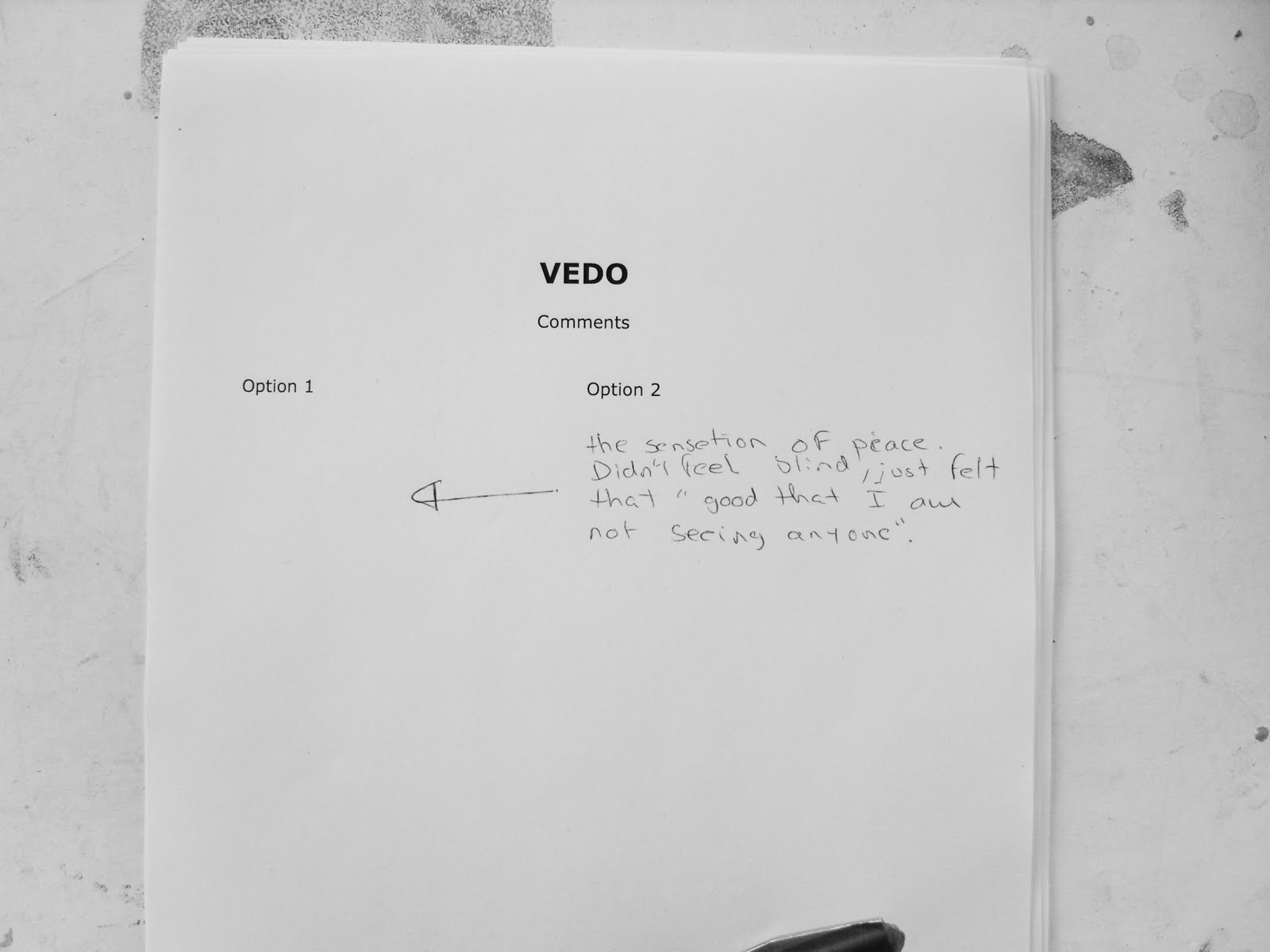
Aim: offer a simple game, giving two options to potential paticipants. Put part of my final show to the test.
Why: Experiment, examine people's responses, get feedback.
Result: for the whole day, one person only (a friend) spared five minutes to participate. 
It was clearly a fine art environment, where people were not interested in anything that involved a performative discipline. I certainly do hope that in September we will get more open audiences.


Tuesday, June 8, 2010

Organic Self - Pictures

Click here for more info on this performance


Dancers and Performers wanted!

How my final show is going to be is all in my head, developing, and it's already taken shape on some sketches.
I will need more than one performer, so I am in search of performers at the moment! Join the facebook event and share!
http://www.facebook.com/event.php?eid=103342179714312


DANCERS AND PERFORMERS WANTED!

Are you interested in being part of an MA final show performance in September?
Want to show off you performance skills?
Ready for a new experience?
Keen on collaborating with others?


We are looking for contemporary dancers and performers with some experience on stage, for a participatory performance that deals with the senses and invites spectators to explore them.


General Rehearsals: 7 and 8 September
Premiere: 9 Septemeber
Replicas: a few of them from 10 to 16 September (exact dates to be confirmed)

All takes place at Wimbledon College of Art!

Contact Milka at:
07760505783

Saturday, May 29, 2010

Top Secret

Recently I contacted the creators of You Me Bum Bum Train and have volunteered to participate in creating the project that is to be presented throughout July. I am currently helping out with building sets and will be one of the two hundred performers. It is fun to be involved in a project of this size, so I am looking forward to the final results (all tickets have been sold already by the Barbican).
Till then I can say no more, it's top secret.


Organic Self#2

While in presenting Organic Self for the Interim Show I had aimed at making the relationship between performers and audience members evident through the interaction of sound (produced by spectators) and movement (produced by performers), Organic Self#2 was entirely about audience and their interaction with one another.
It focused on touch and hearing, while vision was eliminated at the very beginning by blindfolding all participants. The 'flute players' were seperated in two small groups of six people each, facing each other within the space. Were they not blindfolded, they would have been able to see each other and their reactions would have been largely dependent on seeing. Once vision was eliminated, they could feel more free to interact and would feel less inhibited. Of course, this meant that they would have to trust their sense of touch to understand how the organ worked. Considering that vision is the sense we rely on most, everyone took their time until they realised how things were to work. Especially those sitting in the back row, whose 'task' was to pass the signal by touching the people in front of them, left themselves be entirely manipulated and rarely passed the signal; this was very different when audience members were not deprived of seeing in Organic Self.
On overall people enjoyed it. No doubt some were uncomfortable in a situation like this, exactly becasue we do everything by looking first and then turning to our other senses as reference. Somebody said they were 'unnerved' by the fact they couldn't see, while another said 'It made me feel calm'. Surely, all of us discover how their other senses work when we are deprived of one of them.
Some pictures, courtesy of Liushan Lin


Monday, May 24, 2010

Organic Self#2 at 3rd CCW Salon

Things are happening so fast these days I haven't been able to update on my plans for my off-site showing. Few days ago I received an email for participation at the 3rd CCW Salon at the Flat Time House. I thought it was a great opportunity to meet new people and show my work outside college, combining this with one of the requirements this last term (presenting work outside school premises).
I had thought about proposing either What you see is what you get? or Organic Self again. I sent in documentation and info on What you see is what you get? and was pleasantly surprised to be invited to perform tomorrow, Tuesday 25th of May. Today I went to see the space, a really nice venue, which despite its clean, white, gallery walls feels quite cosy, probably because of all the small spaces of which it's made up, including a lovely kitchen. It is the former residence of the late artist John Latham.
With Josh's and John's help we tried to find the right spot for my piece, trying to black out one of the spaces. However, it was impossible to get a completely dark space, which is needed for the torch effect and the complete impossibility to see for the audience that it very important at the beginning of the piece. The place is full of light and it gives you a lot of space to breathe, so it was probably wrong to try and black it out anyhow. So I thought it was the perfect venue for the new version of Organic Self. After trying out a few arrangements I was convinced it was the right choice for the space. I am excited about taking this piece one step further!
Join in tomorrow, Tuesday 25th of May
At the Flat Time House
210 Bellenden Road
London SE15 4BW
Program:
2-5pm - Tea and open viewing of the works
6-8pm Performances
8-9 closing drinks


Wednesday, May 19, 2010

Questions rising, intertwining and then going their own way...

Yesterday we split into groups and did a brainstorming of the ideas behind our work. It was interesting to see how some elements or issues that concern us linked, maybe something we hadn't realised before, and yet how differently we can all look at the same question.
Here's the map I plotted while discussing with my group.
We will continue on defining the main questions we want to exapnd on as we are working for and preparing for the final show.


Monday, May 17, 2010

Plans for June


As June is getting nearer, it was important to make sure I have a space for the showing outside college. Various places I checked out have already been booked, while another had some strange requirements, including the fact that my audience had to take their shoes off. Also, most places are quite expensive, so the best option was to hire a place with a group of people, which not only has the advantage of sharing costs, but also presenting different work within one space, thus bringing in more audience.
A few of us went to check out the Rag Factory in Brick Lane, where I had performed a few months ago. It seems we have just managed to book two spaces for a day at the end of June. 
I will present What you see is what you get, taking advantage of the fact that this piece requires a closed space. The idea I dropped was presenting 'Organic Self' in a park, as the weather is not looking good and I don't want to take risks at this point. I wouldn't want to freeze outside and put another performer through the suffering, along with all the participants involved!

Wednesday, May 12, 2010

Space Space Space

Third and last term is kicking off! And it's time to present one of my pieces in a space outside school. I had been meaning to do that since presenting my first piece last December. However, I had realised how hard it is to find a venue in London that will not charge you a high price, making it really difficult for a full-time MA student who would not exactly be described as rich and economically independent (speaking for myself of course!)
Even big festivals like The Fringe in Edinburgh charge you for every single thing, from the hiring of a space to any minimal technical assistance, and this advantage is reserved to the selected artists and groups. Looking at the costs one wonders whether it's worth it to even apply.
It is no doubt a must to get out there, so in my current hunt for a venue, I do hope to get lucky. My advantage is that having more than one piece to choose from, I am flexible with spaces and have even thought of doing it outdoors. Problem is, outdoors is a synonymus to bad weather these days...
Let's see

Saturday, May 8, 2010

Singing and dancing along (A look at participation in a Rembetiko concert)

Going back home to the sunny island of Cyprus, for as much work as I had to do in such a short period of time, I had to go and listen to a live music performance of Rembetiko. 'The Mediterranean Blues', a common description for this style of music, which is still much appreciated in the countries where it was born, gives rise not simply to concerts in laid back restaurants and cafés but to a quickly spreading audience participation.

Rembetiko developed in the 1920s and 1930s in the port cities of Greece, among communities uprooted from Asia Minor in the population exchanges after the Treaty of Lausanne. This mixture of Oriental classical music, Greek folk music and Western urban environment created a unique style. With its “limping” rhythm and lyrics about depression, drugs, prison, death and unrequited love, Rembetiko became the expression of the outcast. Banned in Greece by the dictator Metaxas and in Turkey by Ataturk, Rembetiko is now been rediscovered, shared and celebrated by many from both countries.

The three performers were sitting on a table like ordinary clients, with their food and drinks in front of them. Tuning in instruments as if it were the most natural thing, they started off by playing a few familiar songs. Very soon, more people started arriving while some of them whould sing along in a low voice. The musicians nodded with satisfaction at anyone brave enough to join in even if omitting some of the lyrics. The clapping of hands that follow the rhythm of tunes is an alternative for those who are too lazy to sing, however, it requires quite an amount of experience as the uneven rhythms can often fool you. Some would also make requests for a song to the musicians by singing the first lines, and by the end of the night everyone was singing and dancing, having made contact with at least one other table of people besides the one occupied by the musicians.

Scene from Kostas Ferris' film Rembetiko

I believe that music is an art that reaches its spectator/listener with an immediacy that no other does and it has, thanks to this immediacy, managed to preserve audience participation as one of it elements-something other performative arts have lost throughout time. Audience participation in this case however is not only triggered by the music itself but by the casual setting (an unpretencious and friendly restaurant). Although it is true to say that all spectators here were out for a treat and were therefore pre-disposed to joining in and contributing to the performance, also given their backgorund and traditions, the dynamics of audience-performer influence is evident and undoubtedly has its roots with the very first musicians of Rembetiko.

After its official ban, the Mediterranean Blues had to be practiced in secret, which made
the sense of community created within those gatherings even stronger. People met and all participated in something that was not legal; whether musicians or not, they were all transgressors in the eyes of the state and on this common grounds the gap between performer and spectator never even had the time to form. This is why singing along with the musicians and singers is welcomed, as Rembetiko is about sharing.

The style of making Rembetiko and participating in it has preserved its original meaning, and although it is obviously not banned today and is no longer considered the expression of an outcast's life, musicians and audience come together not only to celebrate the Blues of the Mediterranean but to be part of a community.

Audience-Actor Ratio 1-200

You Me Bum Bum Train takes a single spectator for a wheelchair ride, on a journey of different scenarios that are made up of no less than two hundred actors and performers. A 40-minute adrenaline session gives spectators a condensed taste of real life situations (some less 'real life' maybe)- from going to the dentist, assisting a bull fight and being famous to becoming a translator of a language you don't even know!


Role reversal takes another dimension here, as spectators are not simply becoming actors through the interaction with other performers. The presence of such a large number of performers for a single spectator shows the attention given to each participant, clearly concentrated on the personal experience of spectators. They are cured, adored, provoked, put under examination by the performers. Hence, the strong impact on spectators, who describe it as one of the most powerful experiences in their lives. I wouldn't blame them, despite the fact that You Me Bum Bum Train is not real life. But how many times do we happen to have 200 people there for us, constantly creating an imput for interaction?

The concentration of different situations in which the spectator is put inevitably wakes up their senses, which is another reason why I find this participatory performance so interesting.

Thursday, May 6, 2010

A story told through sensorial experience (I Fiori del Te' by gruppo LIS)

Few years back I participated in an itinerary performance, the rituality of which involved its spectators by engaging their senses of touch and smell apart from vision. I Fiori del Te' (which means 'The Tea Flowers' in Italian) was presented as part of an annual art festival, Fabbrica Europa. Since my work has evolved around sensory experience and audience participation, I recall this piece quite vividly and haven't happened to see anything like it ever since.

Gruppo Lis took its spectators on a journey that illustrated the Japanese ritual of tea through letting them explore their sensorial perception and thus making the delicate story somehow more accessible and real. Each participant was separately greeted by a performer with a hug and led into another chamber. The dark atmosphere suggested from the beginning that vision was not the only sense that was to be explored and used in this performance. One by one, audience members assembled in a dimly lit chamber and were seated on the floor. As the performers began to recite part of the story, people were given little knives and before we realised we were all engaged in peeling potatoes together. The lack of light made it a highly sensorial task, which brough together everyone in the room, including the performers.


The sense of touch and manuality were explored individually although by using the same elements audience members became part of a community. The simple manual task emerged spectators in the rituality that is attached to the growth and preparation of tea in the Orient.

The itinerary nature of the performance made spectators feel more participative as we were led to new rooms, each with different settings as every time another episode of the story unfolded. The performative actions, which concentrated on the visual perception of spectators, blended with moments of haptic experience, triggered by the settings and objects within the spaces. As single moments were marked by different places, it became clear that each episode contained its own ritual, whether it included visual, auditory or haptic involvement.

Barefoot, participants were conducted to a path of warm earth in order to reach the chamber where the story came to an end. The act of walking itself was transformed into a sensual experience, leading the audience into the conclusive act of the performance.

I Fiori del Te' made its spectators part of the performance by physically making them aware of the rituality that is contained within the Eastern tradition of tea. The theme of the performance perfectly matched its sensory elements, thus making the piece a very special event that hovered between theatre, performance and ritual.

Saturday, April 17, 2010

Organic Self


Orgnic Self was the participatory piece I presented with my sound designer Giacomo Natali, as part of the Interim festival Rendering53% at Wimbledon Colleg of Art. 

It was a great way of working in the college theatre and try a piece where the audience was directly involved in the piece, as the communication between participants was encouraged in order to produce the soundtrack for the piece. It was repeated twice, and as the audience responses were different, it was evident how the dynamics of the piece changed according to audiences' interaction. 


In my previous performances audience was offered the task of lighting the piece, or dressing the performer. Here, music was created by the twelve participants. Although the second time spectators were less, and I had advertised that the piece would take place only when that number of participants was present, we decided to take the risk and give it a try. After all, any instrument may still make music even if a couple of strings or keys are missing!


I will soon post theatre plan and documentation of the show.

Monday, March 29, 2010

Lab Two Report. We all have a responsibility

Right...Not too sure what the layout of a proper lab report (that is not a physics or chemistry lab) should be like. So here is the feedback sheet I gave out to spectators after the performance. Those were the main questions discussed, although the talk was very open and different opinions regarding various aspects of the work were shared.


The primary question I was addressing was the audience space. All spectators had been facing a different direction, and I was happy with the result, as everyone had encountered some kind of difficulty in understanding where to look. Some had felt embarassed to move around in order not to make noise, others were in a place where the two main screens where an action took place were clearly visible at the same time, while somebody felt like 'being all over the place'. It was less than a 10 minute performance, and some complained of a neck pain... Well, tough, it's up to you how you treat your neck!
I must be honest, very few people gave constructive comments, provided that those labs were meant for constructive discussion, testing ideas and hopefully finding out what works and what doesn't. No doubt I had fun receiving silly  comments from people who were simply maybe too tired or not in the mood, and as much as I may be considerate of my fellow workers' opinions, I shall remain concentrated on the comments I found constructive and therefore useful for my work.


I felt it is necessary to stress this point exactly because my work starts with the audience and their role. I recognise the complexity of spectatorship and my research aims at reflecting the spectators' complexity in terms of vision, auditory interpretation, physical space. I have a responsibility for what I do and how it is interpreted, but in this case the audience had a responsibility of giving constructive comment and they did not.


Fair enough, the following can be deducted from the more active members of audience:


1.Sitting arrangement was interesting, even if it created limits. To make audience members freer to move chairs the use of chairs of stools (with no back) can be used. Also, why not stools with wheels?
Why was the audience seated? Technical problems (lights and video screen couldn't be fixed high enough, so everyone's shadow would have been cast on the screens)


2. Visuals in different places were interesting because it gave a choice. This is what it was meant to do, although some felt that they couldn't see everything. But in the way we interpret do we actually see everything? What is everything?
The piece dealt with a curious case of a visual interpretation disorder. Maybe I was actually able to transmit the notion of a visual disorder.


3. The dialogue sequence (possible thanks to a collaboration with Lauren and Jeanne) was for some very good, as it enriched the piece. Others felt it was confusing. Those are two very different statements. Not because the latter implies that the speech performance was not a very good idea, but because they are of different nature. One has to do with structure of the piece and the other interprets one aspect of it. Well the two voices were really one person that had two minds: a visual and an emotional one. It is impossible not to mix them up!
I think that technically Lauren and Jeanne did a very good job. Of course time was as usually a problem and they didn't have enough time to rehearse (and of course for an ongoing project I would feel obliged to pay them!). However, from experience, voice work develops over time, and especially when working with always the same people, a certain rhythm develops, where the beat and time of words flows according to unknown rules.


4. The domino sequence. Managed to get some interpretations, although a few people found it was not necessary to attribute any meaning to it, as visually and sound wise they created a good effect. For another they marked the beginning and the end of the piece, which they accidentally did! They did mark two different interpretations of vision. To another they carried the weights of trauma, fate and reflection. I guess it was a chain reaction I wanted to include for its marking sound, that has to do with a rhythm in time. Visually a chain reaction shows how one thing leads to another and another again, which does have to do with the complex neurological system of vision and emotions.


5. Light stripes. Somebody recalled a similar effect from my first piece (What you see is what you get?). Am I developing a style here? The overhead projector was the best option for this, as darks are stark dark and lights are shining. A video may be endlessly versatile in the sequences of lines, but the darks are still projected black light, which does reveal what is in front of it. 
However, I would like to do some further video testing. 
The sequence appeared to be interesting in the beginning, when my body was not yet fully visible. Once I was fully visible, although the dark stripes hid some parts, one could make up even what was not seen. This was a very good comment. It is really difficult to know what actually people see when I am performing. I did film myself to see the effect and asked somebody to do a few movements with the light sequence, but it is different live and when you are in it! Since the whole point of this part had to do with seeing parts of a whole and never the whole thing, a more interesting light sequence will be tested soon despite the fact that a projection sends out more light. I will look into it, portakabin here I come!


6.Would people come to see my next work? Not many answered this, so I guess they didn't get time, didn't feel comfortable with it or just didn't want to say 'no'. A funny one was 'not unless it's free'! This was hilarious, honesty appreciated. But then again...I must remain faithful to analysing and responding. If I work towards encouraging an active audience, I must be an active performer and an active receiver of feedback. We all go to concerts, exhibitions and events that are free. It's a way of seeing more without spending much, and especially for students this is a big advantage. However, if I saw singer X for free a couple of months ago and found him utterly boring and unoriginal, I would definitely not go to see him again, even if it's for free. Why would I waste my time? I think this answer has to do more with the relation that the spectator has with money, and had nothing to do with the way my performance was presented and its structure.


Well, there goes a performance lab report. If it may not be of any use to anyone, it certainly has been good for me to gather a few reflections.


Some pictures from the show, kindly offered by Dun Yu:


Saturday, March 27, 2010

Technical matters

I was quite happy with Lab Two on Thursday, it all went as planned, I got to collaborate with Lauren and Jeanne for the dialogue part, received some constructive feedback.


Here's my technical plans regarding set-up, lights, performers.
A report on aims achieved will follow.


Wednesday, March 24, 2010

Reading between the (visual) lines


Lab Two - A Self Interview

What do I hope to achieve?

I want to create a space for the audience, where they feel free to turn around and look in different directions. I will be using different elements within the piece, which can be viewed from different angles, thus providing a choice of different visual as well as auditory imput.
I want to find find out how safe the audience feels with being in the middle of a performance space, which is an audience arrangement I want to use for the Interim Show.
Further, it is important for me to get feedback on the reception and interpretation of the signifiers within the work, which draws inspiration from a curious case of a neurological disorder described by Oliver Sacks.

Why do I want to achieve this?

In my previous work I looked for different ways of making audience discover and see through unconventional ways of lighting and stage design, which inevitably involved audiences' participation through their use of other senses such as touch and smell. This research has taken me further into questioning audience participation and its mechanisms. Although this piece is not of direct audience participation, it will examine the physical settings for audience involvement, which is an integral part of the project for the Interim Show in April.

What research questions am I asking?

I will be addressing mainly practical questions that regard the audience engagement. I would like to see how they can interpret and interact within a space that is not designed for a conventional audience. Furthermore, I am experimenting with live dialogue, which is something I hadn't employed in my past two performance pieces.

Note: My original idea was to invite the audience to join in the dialogue, but I decided this is not a good idea (at least at this point) as spectators may feel intimidated. I don't like hearing my own voice, and knowing that I am not the only one, why should I push the audience into something like that? For me audience participation must be a natural reaction only triggered by performative elements. 

Wednesday, March 17, 2010

Back to Weighting Time

I was so absorbed by our first written assignment over Christmas that I missed posting some documentation of The Weighting Frame, which was a big group  project we presented at the theatre in Wimbledon College of Art right before breaking for winter holidays.

Now that I have started on planning my show for the Interim festival in the second half of April, which will take place at the theatre, I looked at the theatre plan for measurments and came across some images.

Almost all of us were performing or working on technical matters so we were unable to actually see the performance, but I think it was presented very professionally and was indeed a very useful and enjoyable experience (apart from painting white panels out in the snow!) 

This is the result of my personal development of the 'Insignificance' room:


Some  great pictures by Dun Yu of the whole set:


Monday, March 15, 2010

Chain Reactions

Following up my comparison of audience participation to a chain reaction, I couldn't help thinking of the simpliest home made chain reaction, which everyone has made at least once in their life. I got these wonderful white domino sets and tried out arranging a chain. So I will be shooting a short video in the observatory soon to use for my next piece.